RESEARCH AND ICONOGRAPHY
on
« Chromatic filters in 21st-century figurative painting a study of a contemporary symptom »
WORDS AND RESEARCH : Emma Gontier
STUDY SUPERVISION : Philippe Dagen
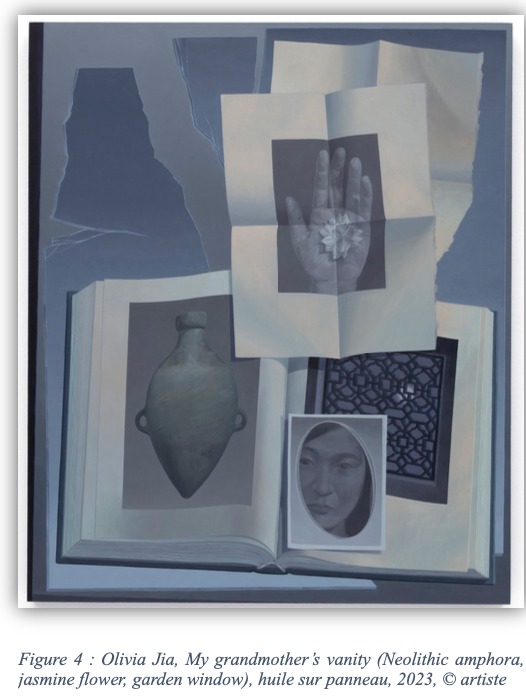
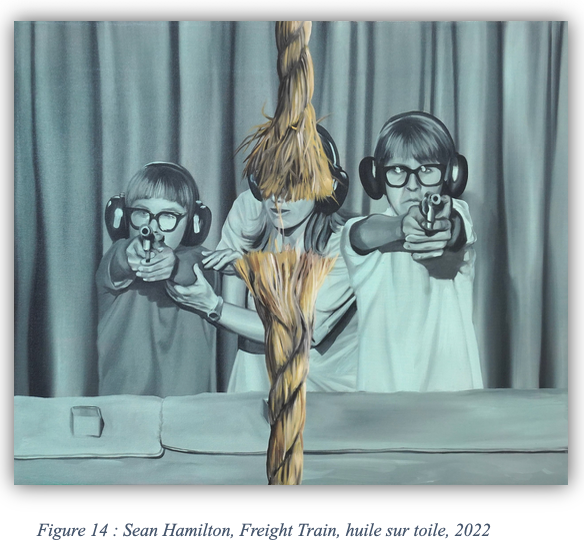
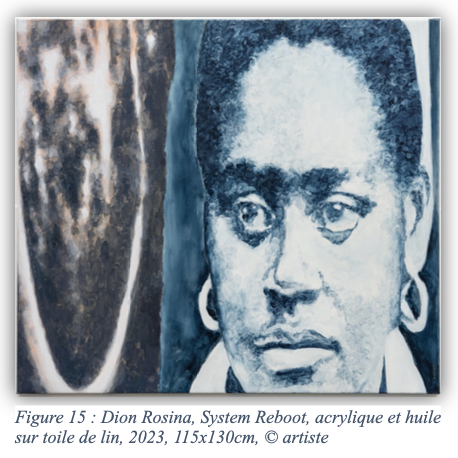
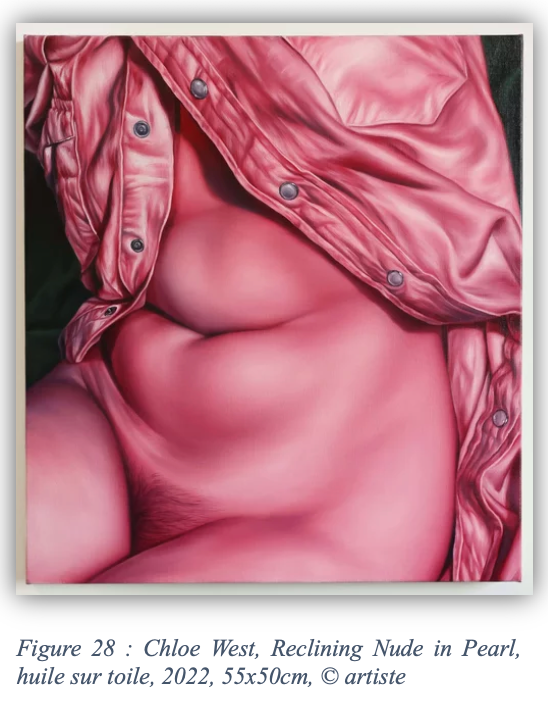
INTRODUCTION
Since the Second World War and the emergence of abstraction, since Vassily Kandinsky’s first and much debated watercolour, the arrival and rapid democratisation of photography and then, as Luke Smythe points out, the confrontation with the digital image, the durability of figurative painting and the perception of colour reality have for decades been called into question. The presence of figuration in painting, without disappearing, became disparate. Artists are abandoning its use, as it no longer corresponds to the expectations, needs and desires of a society still reeling from globalised wars and the growing influence of information technology. The representation of figurative visual artists in institutions and galleries, and consequently their visibility, is diminishing. But over the last few decades this trend has gradually been reversed.
First artists, then enthusiasts, collectors, institutions and critics are loosening the stranglehold on figurative art, and today it is back in the limelight. What better illustration than the French exhibition ‘Immortelle: Vitalité de la jeune peinture figurative française’ in Montpellier this year, which showcased the emerging figurative painting scene with over 250 works by 90 different artists. The term Immortelle is actually rather ironic, given the extent to which contemporary figurative painting has been shelved for over half a century. But leaving aside this recent consecration, it is on the basis of the figure of Jacques Monory that we need to retrace part of the historiographical assessment that leads to the analysis of the chromatic filter as a practice. Jacques Monory developed a unique aesthetic, mostly in blue monochrome, with genre film and press photographs reporting events of the day as his main inspiration. His unique and decisive influence, alongside that of Gerhart Richter and Luc Tuymans to name but a few, has restored the reputation of figurative painting, and given today’s artists unprecedented keys to the renewal of pictorial art, advocating freer creation in its use of the various media and mediums available, and instigating a profound change in painters’ awareness of colorimetry.
In the continuity of this intermedia creation, which makes use of communication and social networks as both a medium and a tool for dissemination, as well as an intermedium, the association of the polysemous notion of archive with that of contemporary art has become increasingly obvious as numerous authors, critics, curators and historians have attempted to study this strengthened link since 1995. A number of texts mark this emergence: The archival power of the archive de Chris Marker in 2002, The Artist as Historian, Mark Godfrey in 2007, An Archival Impulse Hal Foster en 2004, or 2006 edition entitled « Archive » from the series Documents of Contemporary Art published by Whitechapel Gallery and MIT Press8 . The archive, understood in this study as a referential source of imagery of various kinds used upstream in pictorial creation, has, in its junction with art and painting, sometimes taken the aesthetic form of figuration under chromatic filters. This junction, moreover, has become an aesthetic method of figuring the idea of archiving. A handful of pioneering artists gave initial visibility and reality to this singularity. As mentioned above: Gerhart Richter, Jacques Monory, Luc Tuymans, Lorna Simpson and Mark Tansey have, to a certain extent, given the idea of associating the archive with painting a materiality and an aesthetic through color. This iconographic and aesthetic contribution, which we will study here, is of course the fruit of numerous social changes and a polymorphous creative and media conjuncture, which this work will explore with the help of interviews and external and subsequent sources that are intended to be as contemporary and serious as possible. It also has its origins in a visual observation, faced with works whose inspirations are certainly diverse but whose aesthetics are similar.
The only definitive common denominator in the definition of the chromatic filter is its construction as a stratified layer, a processual stage in the construction of a new image based on a pre-existing one. Its other characteristics have more to do with individual games, which nevertheless come together in the questions of ontological changes to the image, distancing, curation, the pure creative process in its materiality or differentiation through the use of colour.
It is therefore essential to examine the origins and triggers of the acceleration of this phenomenon in contemporary pictorial production, to attempt to define its contours by establishing an encompassing definition, and to draw up a labelled guide to the thematic concerns associated with this aesthetic practice. The contraction of this chromatic filter, an aberration in the mimetic use of reference images, called an archive in this research because of its particular temporal dimension, will raise the question of the link between archive and art and what influence this link may have on the chromatic choices of the artists in the corpus. Secondly, the aim of defining the chromatic filter will be to give it theoretical consistency and to characterise it using terminologies that are sufficiently specific and in-depth to enable a precise analysis and identification of the phenomenon. Finally, the breadth of the selected corpus will allow us to group the subjects of the individual canvases thematically, in order to extract an in-depth analysis of the cause-and-effect relationship between aesthetic (in this case chromatic) choices and the subjects addressed.
Emma Gontier
BIBLIOGRAPHY
1 After the Historiographic Turn: Current Findings – e-flux 9 Quoted in Anselm Franke and Hila Peleg, “The Soul, or, Much Trouble in the Transportation of Souls,” in Manifesta 7: Index, ed. Rana Dasgupta, Stephen Haswell Todd, Dan Kidner (Milan: Silvana Editoriale, 2008), 122
2 Krug, Don H. « Electronic Media and Everyday Aesthetics of Simulation ». Visual Arts Research 28, no2 (2002): 27-37.
3 and 4 Slaughter, Annie Lyall. « Why Figurative Artists Have Turned to Monochromatic Palettes ». Artsy, 26 mars 2024.
https://www.artsy.net/article/artsy-editorial-figurative-artists-turned-monochromatic-palettes
5 Chris Marker, The archival power of the archive, 2002
6 Mark Godfrey, The Artist as Historian, 2007
7 Foster, Hal. « An Archival Impulse ». October 110 (2004): 3-22. https://www.jstor.org/stable/3397555.
8 « Archive » de la série Documents of Contemporary Art publié par Whitechapel Gallery et MIT Press.